
| Document Title | Malvern International Group – Group Health & Safety Policy |
| Document Number | HSP/MIG/001 v1.5 |
| Policy Author | Chief Operating Officer |
| Policy Owner | Chief Operating Officer / Group Health & Safety Coordinator |
| Approved By | Chief Executive Officer / Chief Operating Officer |
| Date Approved | 29 June 2026 |
| Next Review Date | June 2027 |
| Distribution | Group wide |
| Confidentiality | Internal – Controlled Document |
| Version History | v1.5 — 29 June 2026 |
Statement of Intent
Malvern International PLC is committed to ensuring, so far as is reasonably practicable, the health, safety and welfare of employees, students, contractors and visitors. The Board recognises health and safety as a core component of governance, operational excellence and risk management.
Scope and Application
This Policy applies to Malvern International PLC and all subsidiaries, divisions, teaching sites, residential sites and administrative locations.
Introduction
This policy is for Malvern International PLC and all subsidiaries including:
- Malvern House Group Limited
- Malvern HE Partnerships
- Malvern House International Limited
This Health and Safety (H&S) Policy is divided into three distinct sections as follows:
SECTION 1 – Health, Safety and Welfare Policy Statement
This section outlines the overarching aims and objectives of the Group Health & Safety Policy. The statement is formally approved by the Chair of the Health and Safety Committee and subsequently ratified by the Malvern International PLC Executive Board.
SECTION 2 – Organisation
This section defines the organisational structure, governance framework and allocated responsibilities established to ensure the effective implementation of the aims and objectives set out in this Health and Safety Policy.
SECTION 3 – Arrangements
This section outlines the specific procedures to be followed by staff, students, visitors and contractors to ensure effective implementation of the Health and Safety Policy and the maintenance of a safe, healthy and supportive environment. Where detailed procedures are contained within separate standalone policies, these are clearly referenced within this section for ease of access and compliance.
SECTION 1 – Health, Safety and Welfare Policy Statement
Malvern International PLC (“the Group”) is committed to ensuring, so far as is reasonably practicable, the health, safety and welfare of all employees, students, contractors, visitors and any other persons who may be affected by its activities.
The Board recognises that effective health and safety management is an integral component of responsible governance, operational excellence and educational quality. Health and safety is embedded within the Group’s overall risk management framework and is treated as a core organisational priority rather than a standalone compliance function.
The Group is committed to:
- Providing safe premises, safe systems of work and safe equipment.
- Identifying hazards and assessing risks in a systematic and proportionate manner.
- Implementing suitable and sufficient control measures to mitigate risk.
- Providing appropriate information, instruction, training and supervision to ensure competence.
- Promoting a positive health and safety culture across all subsidiaries and divisions.
- Ensuring effective consultation and communication with employees and relevant stakeholders including University Partners.
- Monitoring performance through inspection, audit and reporting mechanisms.
- Complying with all relevant statutory and regulatory requirements.
- Reviewing and continually improving its health and safety arrangements.
The Board retains ultimate accountability for health and safety performance across the Group. Operational responsibility for implementation rests with the Chief Operating Officer, supported by the Group H&S Coordinator (Matthew Huda) and subsidiary leadership teams.
Health and safety governance is integrated with the Group’s Business Continuity Plan (BCP/MIG/001) and Safeguarding framework to ensure coordinated and proportionate responses to incidents that may impact welfare, operations or reputation. The BCP establishes the Group’s Central Leadership Emergency Team (CLET), alert thresholds and incident management protocols; this Health and Safety Policy operates within and alongside that framework. Any H&S incident meeting the thresholds set out in the BCP must be escalated in accordance with BCP alert procedures as well as the reporting requirements of this policy.
This Policy will be reviewed annually, or sooner where significant change or incident requires it, and will be communicated to all employees across the Group.
Signed on behalf of the Board of Malvern International PLC:
Richard Mace
Chief Executive Officer
Malvern International PLC
Chief Operating Officer’s Statement
As Chief Operating Officer of Malvern International PLC, I recognise that effective health, safety and welfare management is not achieved through policy alone, but through leadership, behaviour and collective responsibility across the Group.
While I hold operational responsibility for the implementation and oversight of this Policy, creating and sustaining a safe environment depends on visible leadership at every level of the organisation. Health and safety must be embedded into daily decision-making, operational planning and the way we conduct ourselves as colleagues, educators and leaders.
We are committed to fostering a culture where:
- Safety is considered before performance.
- Concerns can be raised openly and without hesitation.
- Incidents are reported transparently and investigated constructively.
- Learning from experience is valued and shared.
- Compliance is viewed as a minimum standard, not the end goal.
Health and safety governance is fully integrated within our Business Continuity arrangements (BCP/MIG/001) and Safeguarding framework, ensuring coordinated and proportionate responses to any event affecting the welfare of our students, staff or wider community. The BCP defines the Group’s escalation structure, Central Leadership Emergency Team (CLET) and alert protocols; this policy operates alongside it. Staff should be familiar with the BCP’s 60-Minute and 24-Hour alert thresholds and their escalation responsibilities under this policy.
I expect all leaders across the Group to demonstrate active ownership of health and safety within their areas of responsibility and to model the behaviours that underpin a strong safety culture. Every employee, regardless of role, has a duty to contribute to maintaining safe working and learning environments.
Through continuous monitoring, internal audit, open dialogue and shared accountability, we will strengthen our safety culture year on year.
James Findley
Chief Operating Officer
Malvern International PLC
SECTION 2 – Organisation
The Group’s approach to health and safety management is based on the framework outlined in the Health and Safety Executive (HSE) publication HSG65: Managing for Health and Safety (HSE, 2013). This framework adopts the Plan – Do – Check – Act (PDCA) cycle to provide a structured and continuous approach to managing health and safety risks.
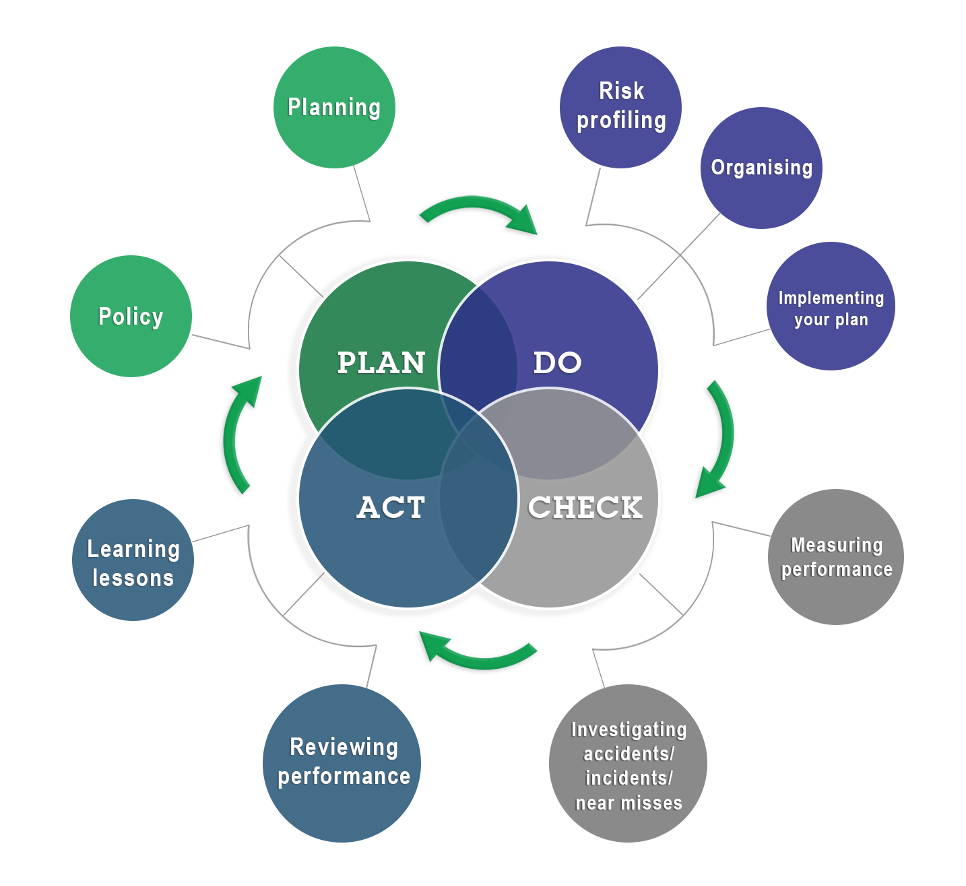
This model enables the Group to balance robust management systems with the behavioural and cultural aspects that underpin effective health and safety performance. The Group’s ethos is to integrate health and safety into everyday management practices, recognising it as a fundamental element of good governance and operational leadership rather than as a standalone compliance function.
Plan
The Group adopts a structured approach to planning for health and safety by identifying hazards associated with its teaching, operational and residential activities and assessing the level of risk involved. Through this process of risk assessment and risk profiling, the Group establishes appropriate control measures to reduce risks to a manageable level. Planning also includes the allocation of responsibilities, the development of procedures and the provision of appropriate resources to support safe working and learning environments across all subsidiaries and sites. Health and safety planning is integrated with the Group’s wider operational and risk management arrangements to ensure that the welfare of students, staff and visitors remains a central consideration in decision-making. A standard Group risk assessment template and responsibilities matrix are being developed by the Group H&S Coordinator to support consistent implementation across all sites and will be issued as supporting guidance in due course.
Do
The Group ensures that the arrangements identified during the planning stage are implemented effectively through clear organisational structures, defined responsibilities and appropriate training. Leadership for health and safety rests with the Chief Operating Officer and is supported by the Group H&S Coordinator (Matthew Huda) and subsidiary management teams. Managers are responsible for organising activities within their areas and implementing safe systems of work. Staff are provided with the information, instruction, training and supervision necessary to perform their roles safely, ensuring that health and safety considerations are embedded within day-to-day operations across all sites.
Check
The Group monitors its health and safety performance to ensure that policies, procedures and control measures remain effective. This includes regular workplace inspections, review of risk assessments, and the reporting and investigation of accidents, incidents and near misses. These monitoring activities allow the Group to measure performance, identify hazards and determine whether control measures are working as intended. Findings from inspections, incident investigations and other monitoring activities are reviewed by management and reported through the Group’s health and safety governance structures.
Act
The Group is committed to continuous improvement in the management of health and safety. Information gathered through monitoring activities, inspections, audits and incident investigations is used to review existing arrangements and identify opportunities for improvement. Lessons learned are communicated where appropriate to ensure that improvements can be implemented across the organisation. Where necessary, procedures and control measures are updated to reflect changes in legislation, operational practice or best practice guidance, ensuring that the Group’s health and safety management system remains effective and proportionate to the risks associated with its activities.
Health and Safety Responsibilities
The effective management of health and safety within Malvern International PLC relies on clear leadership, defined responsibilities and the cooperation of all members of the organisation. While the Board retains overall accountability for health and safety performance across the Group, responsibility for implementing this policy is shared across all levels of the organisation. Each individual has a role to play in maintaining safe working and learning environments.
Group Management Boards
The Group Management Boards provide strategic oversight of health and safety across the organisation. They are responsible for ensuring that appropriate governance arrangements are in place, that health and safety risks are considered as part of the Group’s overall risk management framework, and that adequate resources are allocated to support the effective implementation of this policy.
Executive Member Responsible for Health & Safety / Chief Operating Officer (COO)
The Chief Operating Officer (COO) has executive responsibility for the operational oversight and implementation of health and safety arrangements across the Group. The COO ensures that appropriate systems, procedures and reporting mechanisms are in place and that health and safety is effectively integrated within the Group’s operational and risk management framework. The COO also receives reports on significant incidents, oversees statutory reporting where required and provides assurance to the Executive Board on health and safety performance.
Group Health and Safety Coordinator — Matthew Huda
The Group Health and Safety Coordinator is Matthew Huda (Matthew.Huda@malvernplc.com). The Group H&S Coordinator reports directly to the Chief Operating Officer and is the primary point of contact for health and safety matters across the Group. The role includes monitoring compliance with health and safety procedures, supporting the completion and review of risk assessments, coordinating inspections and reporting processes, and providing guidance to managers and staff on health and safety matters. The Group H&S Coordinator also assists in monitoring incident reporting and ensuring that appropriate follow-up actions are implemented and will ensure that arrangements are carried out in respect of this policy. Staff are reminded that in the absence of the Group H&S Coordinator, health and safety concerns must be reported to the COO directly.
Key H&S Contacts — Malvern International Group
| Role | Name | Site / Division | |
|---|---|---|---|
| Executive Sponsor / COO | James Findley | james.findley@malvernplc.com | Group |
| Group H&S Coordinator | Matthew Huda | HSE@malvernplc.com | Group |
| Centre Director | Mark Elliott | Markelliott@malvernplc.com | Wolverhampton |
| Centre Director | Nima Nazari | Nima.Nazari@malvernplc.com | London Metropolitan |
| Centre Director | Angela Ellermeier | Angela.Ellermeier@malvernpl.com | East London |
| Head of Student Services | Lucy Smith | Lucy.Smith@malvernplc.com | Cumbria/Lancaster |
| Head of Student Services | Giulia Mella | Giulia.mella@malvernplc.com | Liverpool |
| Juniors Division Lead | Adam Ennis | Adam.Ennis@malvernplc.com | Juniors |
Centre Directors
Centre Directors and Academic Managers are responsible for ensuring that health and safety arrangements are implemented effectively within their respective centres and teaching environments. In many cases, Group activities take place within partner premises. While the host institution retains primary responsibility for the management of those premises, Centre Directors and Academic Managers must work closely with relevant university staff and take a proactive approach to building effective working relationships. This includes ensuring that Group staff and students understand and follow the host institution’s health and safety procedures, communicating any concerns or hazards to the appropriate university representatives, and supporting the effective coordination of health and safety arrangements between the Group and its partners. They must also ensure that relevant risk assessments are completed where required and that incidents, hazards or concerns are reported and addressed promptly.
Senior Leadership Team
Members of the Senior Leadership Team are responsible for promoting a positive health and safety culture across the organisation. They support the implementation of this policy by ensuring that health and safety considerations are integrated into operational planning and decision-making, and by providing leadership and direction to managers and staff.
Academic Managers
Academic Managers are responsible for maintaining safe learning environments within their academic departments or programme areas. This includes ensuring that teaching spaces are safe and fit for purpose, that students receive appropriate H&S information during induction and teaching activities, and that any hazards or defects identified in teaching areas are reported and addressed promptly. Academic Managers must also ensure that teaching-related risk assessments are completed where required and that any teaching staff under their supervision are aware of and comply with this policy.
Operations Managers
Operations Managers are responsible for the day-to-day management of premises, facilities, contractors and site-level H&S compliance within their operational areas. This includes ensuring that site risk assessments are current and reviewed, that contractors are appropriately inducted and supervised, that fire safety and first aid arrangements are maintained, and that any premises-related H&S concerns are escalated promptly to the Group H&S Coordinator. Operations Managers act as the primary site-level contact for H&S compliance matters and are responsible for completing the annual site H&S confirmation returns required by this policy.
Employees (All)
All employees have a responsibility to take reasonable care for their own health and safety and for the health and safety of others who may be affected by their actions or omissions while at work. Employees are expected to comply with the requirements of this Policy and to cooperate with the Group in ensuring that health and safety arrangements are implemented effectively.
In accordance with their duties under the Health and Safety at Work etc. Act 1974 and the Management of Health and Safety at Work Regulations 1999, employees must:
- Take reasonable care of their own health and safety and that of others who may be affected by their actions or omissions.
- Co-operate with the Group, so far as is necessary, to enable it to comply with its health and safety obligations.
- Use equipment, safety devices and protective measures in accordance with the information, instruction and training provided.
- Not intentionally or recklessly interfere with or misuse anything provided in the interests of health and safety.
Employees must also promptly report to their manager or an appropriate member of staff:
- Any work situation which they reasonably believe represents a serious and immediate danger to health and safety.
- Any matter which they reasonably believe represents a shortcoming in the Group’s health and safety arrangements or protective measures.
By fulfilling these responsibilities, employees contribute to maintaining safe and supportive working and learning environments across the Group.
Teaching Staff
Teaching staff are responsible for maintaining safe learning environments and ensuring that students are aware of relevant health and safety procedures during teaching activities. This includes providing appropriate supervision and ensuring that any risks associated with teaching activities are properly managed. Teaching staff should take an active role in maintaining safe and orderly classrooms, including ensuring that teaching spaces are kept tidy, free from avoidable hazards and suitable for learning. Any hazards, defects or unsafe conditions identified within the classroom or teaching environment must be reported promptly through the appropriate reporting procedures so that they can be addressed without delay.
Students
Students are expected to take reasonable care for their own health and safety and to act in a manner that does not place others at risk. Students must follow the health and safety instructions provided by staff and comply with relevant procedures while participating in teaching, learning or programme activities.
In particular, students must:
- Be familiar with and comply with fire safety and emergency evacuation procedures applicable to the building or site they are using.
- Assist staff in maintaining safe and tidy learning environments by keeping classrooms and teaching spaces free from unnecessary hazards.
- Use equipment, materials or facilities only when authorised to do so and in accordance with instructions provided by staff.
- Use any equipment or protective measures provided for their safety in the manner directed by staff.
- Report immediately to a member of staff any hazards, defects or unsafe conditions that they observe within the premises or facilities.
- Report any accidents, incidents or near misses to a member of staff as soon as possible.
- Behave responsibly and cooperate with staff to maintain a safe learning environment.
Students must not intentionally misuse or interfere with anything provided in the interests of health, safety or welfare, such as fire safety equipment or safety devices, nor engage in behaviour that may endanger themselves or others.
Students will be provided with appropriate health and safety information and guidance as part of their induction and during relevant teaching or programme activities to ensure they understand their responsibilities.
Visitors and Contractors (including agents)
All visitors and contractors have a responsibility to take reasonable care for their own health and safety and to avoid acting in a manner that could place themselves or others at risk while on Group premises or participating in Group activities. Visitors and contractors are expected to follow all relevant health and safety instructions provided by staff and to comply with site procedures.
In particular, visitors and contractors must:
- Comply with instructions given by authorised members of staff or site representatives.
- Not tamper with or misuse fire safety equipment, emergency systems or any other safety devices.
- Sign in on arrival using the Group visitor management pack, which includes the site emergency card and H&S briefing.
- Wear any visitor or contractor identification provided while on the premises.
- Report any health and safety concerns, hazards or incidents to a member of staff as soon as possible.
- Use any required personal protective equipment where indicated or instructed.
- Sign out in accordance with the site procedures when leaving the premises.
Where contractors are undertaking work on behalf of the Group and will not be directly supervised by Group staff, they must be provided with appropriate health and safety information and, where necessary, a site-specific induction before commencing work.
Visitors and contractors must also comply with the health and safety procedures of host institutions where Group activities take place within partner premises.
External Health and Safety Consultants (Competent Persons)
The Group recognises its duties under the Management of Health and Safety at Work Regulations 1999 to appoint one or more competent persons to assist in meeting its health and safety legal obligations.
The Group maintains internal competence to support the effective management of health and safety through appropriately trained staff who provide oversight, coordination and guidance on health and safety matters across the organisation.
Where specialist knowledge, technical expertise or independent assurance is required, the Group will appoint suitably qualified external consultants or contractors to provide advice and support. This may include, for example, specialists in areas such as fire safety, water hygiene, building safety, occupational health, risk assessment, or other statutory inspection and compliance activities.
External consultants may also be engaged periodically to provide independent review, advice or audit of the Group’s health and safety arrangements to ensure that legal compliance is maintained and that opportunities for continuous improvement are identified.
Through this combination of internal capability and access to external specialist expertise, the Group ensures that it has access to the competent advice necessary to meet its health and safety responsibilities.
Measuring Performance
The Group measures health and safety performance to ensure that this Policy and associated arrangements are being effectively implemented across all subsidiaries and operational sites. Monitoring performance enables the Group to understand current performance levels, identify areas requiring improvement and ensure that appropriate controls remain effective.
Effective performance monitoring allows the Group to determine key performance indicators (KPIs) including: total incidents recorded per quarter by site and division; number of RIDDOR-reportable incidents; near-miss reports submitted; average time to close incident investigations; mandatory training completion rate by role and site; fire marshal certificate currency across all sites; first aider certificate currency across all sites; and outstanding risk assessment actions overdue at each site. These KPIs are reported in the Annual H&S Report and reviewed at each H&S Committee meeting.
Performance monitoring allows the Group to determine:
- Where we are currently performing in relation to health and safety standards.
- Where improvements are required.
- What actions are necessary to maintain safe working and learning environments.
The Group’s monitoring arrangements consist of two complementary approaches: active monitoring and reactive monitoring.
Active Monitoring (Before Things Go Wrong)
Active monitoring involves regular checks and inspections to ensure that health and safety standards are being maintained and that management controls are operating effectively.
The Group undertakes active monitoring through a range of measures including:
Workplace Inspections
Regular workplace inspections are carried out across operational sites to identify hazards and confirm that health and safety arrangements are being implemented effectively. Inspections may be undertaken by the Group H&S Coordinator, local managers or other designated staff using appropriate inspection checklists. Areas of higher risk may be prioritised where appropriate. Findings from inspections are recorded and any actions identified must be addressed within agreed timescales. Progress against actions is monitored and reported through the Group’s health and safety governance arrangements.
Risk Assessment Reviews
Risk assessments are reviewed periodically and whenever there are significant changes to working practices, premises or activities. This ensures that control measures remain suitable and effective.
Specialist Compliance Inspections
Where required, specialist inspections and statutory compliance checks are undertaken by competent persons, which may include external contractors or consultants. These inspections may relate to matters such as fire safety systems, water hygiene, electrical safety, building safety or other statutory requirements.
Internal Review and Governance Reporting
Health and safety performance is reviewed through internal monitoring and governance processes. An annual Health and Safety report is prepared for the Malvern International PLC Board, providing an overview of performance, significant incidents, compliance activity and areas for improvement.
Reactive Monitoring (After Things Go Wrong)
Reactive monitoring involves investigating incidents and reviewing outcomes in order to identify the causes of failures in health and safety management and prevent recurrence.
The Group undertakes reactive monitoring through:
Incident Reporting and Investigation
All accidents, incidents and near misses are reported and investigated in accordance with Group procedures. Investigations aim to identify root causes and ensure that appropriate corrective actions are implemented.
Incident and Safety Performance Reporting
Incident statistics and trends are monitored and reviewed as part of the Group’s health and safety governance processes. This enables the organisation to identify patterns, address recurring issues and implement appropriate improvements.
Health and Absence Monitoring
Where relevant, information relating to work-related ill health or absence may be reviewed to help identify any health and safety issues that require further attention.
Together, these active and reactive monitoring processes support the Group in maintaining effective oversight of health and safety performance and contribute to the continuous improvement of its health and safety management systems.
Section 3 – Arrangements
This section outlines the operational arrangements and procedures in place to support the implementation of this Health and Safety Policy. These arrangements provide guidance on how specific risks are managed across the Group’s activities and premises. Managers and staff must ensure that these arrangements are understood and applied within their respective areas of responsibility.
Accidents, Incidents and Near Misses
All accidents, incidents and near misses must be reported promptly in accordance with Group reporting procedures. Timely reporting enables the Group to investigate events, identify underlying causes and implement appropriate corrective actions to prevent recurrence.
Managers are responsible for ensuring that incidents within their areas are recorded and investigated proportionately. Where required, incidents will be reported in accordance with statutory requirements, including the Reporting of Injuries, Diseases and Dangerous Occurrences Regulations (RIDDOR).
Information gathered through incident reporting and investigation contributes to the Group’s monitoring of health and safety performance and supports continuous improvement.
Training
The Group will ensure that employees receive appropriate health and safety information, instruction and training relevant to their role. Training requirements may include induction training, role-specific training and refresher training where appropriate. Managers are responsible for ensuring that staff within their areas have received the training necessary to carry out their duties safely.
Communication with Employees
Effective communication is essential to maintaining safe working and learning environments. The Group will ensure that relevant health and safety information is communicated to employees through appropriate channels, including induction programmes, internal communications, guidance materials and management briefings.
Consultation with Employees
The Group is committed to consulting with employees on matters affecting their health and safety. Consultation may take place through formal and informal mechanisms, including staff meetings, health and safety committees or other appropriate forums, allowing employees to raise concerns and contribute to improvements in health and safety arrangements.
Control of Contractors
Where contractors are engaged to undertake work on behalf of the Group, appropriate arrangements will be in place to ensure that work is carried out safely. Contractors must comply with relevant health and safety requirements and may be required to provide evidence of competence, risk assessments and method statements where appropriate. Contractors must also comply with the health and safety procedures of host institutions where Group activities take place within partner premises.
Control of Substances Hazardous to Health (COSHH)
Where activities involve the use or storage of substances that may present a risk to health, appropriate assessments will be carried out in accordance with the Control of Substances Hazardous to Health Regulations. Suitable control measures will be implemented to minimise exposure and ensure that substances are used, stored and disposed of safely.
Critical Incidents
The Group maintains procedures for responding to critical incidents that may affect the safety or welfare of staff, students or visitors. Critical incidents include serious accidents, physical crises, major service disruptions, safeguarding emergencies, or any event that could significantly impact operations or reputation. Responses to critical incidents are coordinated in accordance with the Group’s Business Continuity Plan (BCP/MIG/001), which sets out the escalation structure, the Central Leadership Emergency Team (CLET) framework, and incident management protocols. This H&S Policy and the BCP operate in parallel; an H&S incident that meets a BCP alert threshold must be managed under both frameworks simultaneously.
BCP Alert Thresholds and Escalation Contacts
The Group’s Business Continuity Plan (BCP/MIG/001) sets out the 60-Minute and 24-Hour alert thresholds, escalation contacts and RIDDOR reporting guidance applicable to H&S incidents. The key contacts are: Group H&S Coordinator — Matthew Huda (HSE@malvernplc.com); COO — James Findley (james.findley@malvernplc.com). In any situation involving immediate danger to life, call 999 first.
H&S Incident Escalation to CLET — Key Contacts
Where an H&S incident meets a BCP alert threshold, notify Matthew Huda (HSE@malvernplc.com) and your line manager immediately, then initiate the appropriate BCP alert. The Group H&S Coordinator notifies the COO, maintains the H&S incident record, and ensures RIDDOR reporting obligations are met concurrently with BCP procedures.
Incident Categories and BCP Response Guidance
The BCP provides specific incident management guidance for H&S-related scenarios. For physical crises (fire, flood, explosion, building collapse, or uncontrolled release of gas), site-level emergency procedures take immediate precedence, followed by CLET notification and BCP escalation. For IT failures or system outages that affect the ability to monitor or respond to H&S incidents, the BCP’s IT System Recovery Priorities apply and the Group H&S Coordinator must be notified of any period during which incident reporting capability is impaired. For threats to employees or students (including bomb threats, violence, or extortion), H&S and safeguarding duties operate concurrently with BCP escalation. For public health or pandemic events affecting operational ability, the BCP’s Business Impact Analysis framework guides the proportionate response. The BCP should be consulted directly for detailed action checklists, CLET responsibilities, and communication protocols applicable to each incident type.
Post-Incident Review and Lessons Learned
Following any critical incident or BCP activation, the Group H&S Coordinator must complete a post-incident H&S review in conjunction with the BCP Lessons Learned process (BCP/MIG/001, Section 8). The review assesses whether risk assessments, training or procedures require revision, and whether RIDDOR reporting was correctly handled. Outputs are reported to the COO and presented to the next H&S Committee meeting.
Disabled Staff and Medical Conditions
The Group is committed to supporting employees with disabilities or medical conditions, including temporary conditions where appropriate. Reasonable adjustments will be considered to enable employees to carry out their roles safely and effectively. Individual risk assessments may be undertaken where necessary to ensure appropriate support is provided.
Disabled Students and Medical Conditions
The Group aims to ensure that students with disabilities or medical conditions are able to participate safely in learning activities. Appropriate support arrangements will be implemented where required, and staff will work with relevant colleagues and partner institutions to ensure that suitable adjustments and safety measures are in place.
Display Screen Equipment (DSE)
The Group recognises that many employees use display screen equipment as part of their work. Appropriate arrangements are in place to ensure that workstations are set up safely and that employees are aware of good ergonomic practices to reduce the risk of musculoskeletal problems or visual fatigue. All employees who regularly use DSE as a significant part of their work must complete a DSE self-assessment. Line managers and Centre Directors are responsible for ensuring that DSE self-assessments are completed within their areas and that any risks identified are addressed. Where a DSE assessment identifies a significant risk or an employee reports discomfort, the matter must be escalated to the Group H&S Coordinator who will arrange further assessment or referral to occupational health as appropriate. The Group H&S Coordinator maintains a central record of DSE assessments by site.
Driving for Work
Where employees drive as part of their work duties, they must ensure that they are appropriately licensed, that vehicles used for work purposes are maintained in a safe condition and that journeys are undertaken responsibly and in accordance with applicable road traffic laws.
Electrical Safety
The Group will ensure that electrical equipment used within its premises is maintained in a safe condition. Employees must only use electrical equipment that is authorised for use and should report any defects or damage immediately so that appropriate action can be taken. Regarding portable appliance testing (PAT): for Group-managed premises, the Group is responsible for PAT testing of its own equipment and maintaining testing records. For sites hosted within partner premises, the host institution is responsible for PAT testing of building-owned equipment; Centre Directors must confirm arrangements with the host. Personal laptops and devices brought to site by employees are not subject to statutory PAT requirements and are considered out of scope unless used as the employee’s primary work device on Group-managed premises, in which case a visual safety check is recommended.
Home and Hybrid Working
Where employees work remotely or in a hybrid working arrangement, the Group will provide guidance to support safe home working practices, including a DSE self-assessment for the home workstation. Employees remain responsible for ensuring that their work environment is safe and suitable for carrying out their duties. Detailed guidance on safe homeworking, including workstation setup, lighting, and reporting procedures, is provided in the Group Homeworking H&S Guidance. In the interim, employees should contact Matthew Huda (HSE@malvernplc.com) if their home working arrangement presents a health or safety risk they cannot resolve independently.
Lone Working
Where employees are required to work alone, appropriate arrangements must be in place to ensure their safety. This may include risk assessments, communication procedures and appropriate supervision arrangements. The Group’s Lone Working Policy provides detailed guidance on lone working arrangements, including check-in procedures and escalation routes. All employees who regularly work alone must be familiar with and comply with that policy.
Manual Handling
Where manual handling tasks cannot be avoided, appropriate measures will be taken to minimise the risk of injury. Employees should follow safe handling practices and seek assistance where necessary. Given the Group’s low-risk office and teaching environment, formal manual handling certification is not required for the majority of staff. Awareness-level training on safe manual handling techniques is sufficient for most roles and is included in the H&S induction programme. Where a specific role involves significant or regular manual handling activity, a role-specific assessment will be completed and appropriate training provided.
Pregnant Workers and New Mothers
The Group will undertake appropriate risk assessments for pregnant workers, new mothers and those who have recently given birth where relevant to their work activities. Suitable adjustments will be considered to ensure that risks are managed appropriately.
Slips and Trips
Slips and trips are among the most common workplace hazards. Staff and students are expected to help maintain tidy and safe environments, and any hazards such as spillages, damaged flooring or obstructed walkways should be reported promptly.
Smoking and Vaping
Smoking and vaping are not permitted inside Group buildings or in areas where they may pose a health or safety risk. Designated areas may be provided where appropriate in accordance with site rules.
Violence and Aggression at Work
The Group will not tolerate violence, threats or aggressive behaviour towards staff, students or visitors. Any incidents of violence or aggression must be reported promptly so that appropriate action can be taken. In responding to any violent or threatening situation, staff should follow the site’s Emergency Action Plan (EAP). Each operational site must have a current site-level Emergency Action Plan, developed by the Centre Director or Operations Manager using a standard Group template and reviewed annually. For sites operating within partner university or Juniors programme premises, the primary EAP will be that of the host institution; Centre Directors must obtain a copy of the host’s EAP, confirm it is current, and ensure all Group staff at that site are familiar with it. Matthew Huda is responsible for maintaining a register of EAPs by site and confirming their currency as part of the annual site H&S check. Note: The Group’s obligations under the Terrorism (Protection of Premises) Act 2025 (Martyn’s Law) are under review. Legal advice is being sought and this section will be updated once obligations by site have been confirmed.
Visitors
Visitors must comply with the Group’s health and safety procedures while on its premises or participating in Group activities. Visitors are expected to follow instructions provided by staff and to report any safety concerns they observe.
Fire Safety
The Group is committed to maintaining effective fire safety arrangements across all its premises and activities in compliance with the Regulatory Reform (Fire Safety) Order 2005. Because the majority of the Group’s teaching and operational activities take place within partner premises, the host institution will typically hold and maintain the premises fire risk assessment. Centre Directors and Academic Managers must familiarise themselves with the relevant fire safety arrangements at each site and ensure that Group staff and students comply with them. Where the Group holds or manages its own premises, the Group H&S Coordinator is responsible for ensuring that a suitable and sufficient fire risk assessment is in place and reviewed regularly.
The Group requires the following fire safety arrangements to be in place at each operational site:
- A current fire risk assessment for the premises, either held by the host institution or by the Group for Group-managed premises. Centre Directors must confirm in writing to the Group H&S Coordinator by 31 October each year that the relevant fire risk assessment has been reviewed within the preceding twelve months and remains current. This written confirmation is required for audit purposes and must be retained by the Group H&S Coordinator for a minimum of three years.
- At least one designated Fire Marshal per teaching or operational site, with appropriate fire marshal training refreshed at least every three years. The identity of the Fire Marshal at each site must be communicated to all Group staff working at that location.
- An evacuation plan for each site, either the host institution’s plan or a Group-specific plan where appropriate. All Group staff must be made aware of the evacuation routes and assembly points relevant to their site during induction and whenever they move to a new site.
- Fire drills must be conducted in accordance with the requirements of the fire risk assessment for each site. For Group-managed premises, drills must take place at least annually. The outcome of each fire drill must be recorded using the Group Fire Drill Record and submitted to the Group H&S Coordinator within five working days.
- Enhanced fire safety provisions for programmes involving students under the age of 18 are set out in the Juniors and Young Persons H&S Addendum.
All staff must not interfere with or disable fire safety equipment, must not prop fire doors open, and must report any defects to fire detection, suppression or warning systems immediately to the appropriate building contact or to the Group H&S Coordinator.
First Aid
The Group ensures that adequate first aid provision is available across all sites in accordance with the Health and Safety (First Aid) Regulations 1981. The Group H&S Coordinator maintains a Group-wide record of first aid provision by site and is responsible for ensuring that coverage is appropriate to the activities and population at each location. A First Aid Needs Assessment must be completed for each site and reviewed annually or following any significant change in activity or personnel.
The minimum first aid provision at each site is as follows:
- At least one designated Appointed Person per site at all times during operational hours.
- Where the First Aid Needs Assessment indicates a higher risk or larger population, a qualified First Aider holding a current HSE-approved First Aid at Work (FAW) or Emergency First Aid at Work (EFAW) certificate must be available on site. As a standard threshold, any site with more than 50 students and staff present at any one time requires at least one qualified FAW or EFAW First Aider on site during operational hours.
- A suitably stocked first aid kit must be available at each site. A portable first aid kit must also be taken on all off-site activities, excursions and social programme activities by the member of staff leading the activity.
- All accidents requiring first aid treatment must be recorded in an accident book or equivalent record, and the incident reported to the Group H&S Coordinator.
Enhanced first aid requirements for programmes involving students under the age of 18 are set out in the Juniors and Young Persons H&S Addendum, including requirements for paediatric first aid-trained staff during residential and activity programmes.
Young Persons and Under-18s (Juniors and Pathways)
The Group operates programmes that include students under the age of 18 across two divisions: the Juniors division and, within Malvern House University Pathways, students who have enrolled on a Pathways programme below the age of 18. The Management of Health and Safety at Work Regulations 1999 impose specific duties on employers in relation to young persons. These duties require the Group to undertake a specific risk assessment before a young person commences participation in any programme or activity, and to take particular account of their inexperience, lack of awareness of risks, and stage of physical and psychological development.
The detailed operational provisions for under-18 students are set out in the Juniors and Young Persons H&S Addendum, which applies to both the Juniors division and to any under-18 Pathways students. This Addendum forms part of the Group H&S framework and must be read alongside this policy.
Pre-Programme Risk Assessment
A specific Young Persons Risk Assessment must be completed for each programme or cohort involving under-18 students before the programme commences. This assessment must address: the physical environment and site suitability; the activities and whether any require specific supervision or restriction for under-18s; the supervision ratios in place; any known medical conditions, disabilities or support needs; the lone travel and transport arrangements; accommodation arrangements for residential programmes; and out-of-hours emergency response procedures. The risk assessment must be signed off by the relevant Centre Director or Juniors Division Lead and submitted to the Group H&S Coordinator prior to the programme start date.
Supervision and Staffing Ratios
Appropriate supervision ratios must be maintained at all times during programmes involving under-18 students. As a minimum baseline: during taught sessions, a ratio of no more than 1 member of staff to 20 students applies; during off-site activities, excursions or social programmes, a minimum ratio of 1:10 applies; for residential programmes or programmes involving students aged under 16, a minimum ratio of 1:8 applies during any off-site activity. These ratios are minimum standards; the risk assessment may specify higher ratios where the activity or individual needs require it. Where a partner organisation’s requirements are more stringent than these minimums, the partner’s higher standard applies.
Note — Language in Action (LiA) programmes: Adam Ennis must confirm LiA’s current supervision ratio requirements before each programme season and ensure that Group programmes operating through LiA meet the higher of the two standards. This confirmation must be documented in the relevant programme risk assessment.
Parental and Guardian Consent and Emergency Contacts
Prior to enrolment, the parent or legal guardian of every under-18 student must provide written consent for participation in the programme, including any activities, off-site visits or residential arrangements. Consent documentation must include emergency contact details for at least two adults, medical conditions, allergies, medication or support needs, and consent for emergency medical treatment. This information must be held securely and be accessible to relevant staff during all programme hours.
Medical Conditions and Health Information
Health information for under-18 students must be collected before the programme commences and shared on a need-to-know basis with relevant staff. Where a student requires medication to be administered, written parental consent and clear instructions must be obtained and a named member of staff designated as responsible for medication management. Prescription medication must not be administered without written parental consent.
Off-Site Activities, Visits and Excursions
All off-site activities, visits and excursions involving under-18 students require a specific activity risk assessment approved before the activity takes place. The risk assessment must address route and transport arrangements, venue safety arrangements, supervision ratios, emergency procedures and welfare needs. Parental consent must be obtained for all off-site activities.
Residential Programmes
Where programmes include residential accommodation for under-18 students, a residential H&S risk assessment must be completed. Accommodation must meet appropriate fire safety standards, have a current fire risk assessment, and include a designated residential welfare lead. Males and females must be accommodated in separate areas with clear protocols regarding access. Out-of-hours emergency procedures must be communicated to all students and staff.
Incident Reporting for Under-18 Students
Any accident, incident or near miss involving an under-18 student must be reported to the Group H&S Coordinator and the relevant Centre Director or Juniors Division Lead on the same day it occurs. Parents or guardians must be notified promptly following any incident resulting in injury, medical treatment or significant welfare concern. Where safeguarding concerns arise, the Designated Safeguarding Lead must be informed immediately and the Group’s Safeguarding and Prevent Policy takes precedence.
Juniors and Young Persons H&S Addendum
The Juniors and Young Persons H&S Addendum provides detailed operational guidance supplementing this policy for all activities involving students under the age of 18. It covers the Juniors division and under-18 Pathways students and is being developed by the Juniors Division Lead in consultation with the Group H&S Coordinator. Until the Addendum is published, the provisions of this section and the Group Safeguarding and Prevent Policy govern all under-18 activity.
Welfare Facilities and Workplace Environment
The Group will ensure that appropriate welfare facilities are available for employees and students where reasonably practicable, in accordance with the Workplace (Health, Safety and Welfare) Regulations 1992. This includes access to suitable sanitation, drinking water, rest facilities and a working environment that supports health, safety and wellbeing. For Group-managed premises, the Group is directly responsible for meeting minimum standards. For partner premises, the host institution is responsible for facilities provision; however Centre Directors must confirm as part of their annual site check that welfare facilities are adequate for the Group’s staff and student numbers. Any inadequacy must be reported to the Group H&S Coordinator immediately.
Health and Safety Committees and Governance Structure
The Group maintains a structured approach to health and safety governance through a system of divisional and central health and safety committees. These committees support the effective implementation of the Health and Safety Policy, provide oversight of health and safety performance and enable consultation with managers and staff across the organisation.
Given the nature of the Group’s activities and its low-risk operating environment, formal Health and Safety Committee meetings are held biannually. Additional meetings may be convened where necessary in response to significant incidents, emerging risks or operational requirements.
The Group H&S Coordinator is responsible for coordinating the committee structure, monitoring actions arising from meetings and managing active health and safety cases or investigations between meetings where required.
Outcomes, key issues and recommendations from the committee structure are reported through the Group’s governance framework and escalated to the Malvern International PLC Executive Board, which meets monthly.
Committee Structure
The Group operates the following health and safety committee structure:
Divisional Health and Safety Committees
- University Pathways Health and Safety Committee
- Juniors Health and Safety Committee
These committees review health and safety matters relevant to their respective activities, including incidents, operational risks and compliance requirements. Issues requiring wider oversight or organisational action are escalated to the Central Health and Safety Committee.
Central Health and Safety Committee
The Central Health and Safety Committee provides Group-level oversight of health and safety matters and reviews issues escalated from the divisional committees. The committee considers overall performance, emerging risks and compliance matters across the organisation and provides assurance that appropriate health and safety arrangements are in place.
Meeting Frequency
- Divisional Health and Safety Committees: Minimum twice per year
- Central Health and Safety Committee: Minimum twice per year
- Additional meetings may be held on an ad-hoc basis where required
Committee Membership
Membership of the committees will typically include representatives from operational management, academic leadership and relevant support functions. Membership may vary depending on the committee’s scope and operational requirements.
The Group H&S Coordinator will normally act as the secretariat, supporting meeting administration, recording minutes and tracking actions.
Standard Agenda for Health and Safety Committee Meetings
- Welcome and Apologies
- Review of Previous Minutes and Action Log
- Incident Review
- Accidents, incidents and near misses
- Ongoing investigations
- Health and Safety Performance
- Inspection outcomes
- Compliance updates
- Risk Management
- Review of risk assessments
- Emerging risks
- Training and Awareness
- Health and safety training updates
- Operational Updates
- Facilities or operational safety matters
- Regulatory or Policy Updates
- Any Other Business
- Summary of Actions and Next Meeting Date